Prioritizing the human side of research and innovation at TMU’s Health & Technology Symposium – Research and Innovation
In an era of rapid transformation in health care, a forward-looking symposium at Toronto Metropolitan University (TMU) encouraged attendees to think expansively about the intersections of health and technology both today and in the future – not only in terms of technological breakthroughs, but also in how research and innovation are designed, governed and implemented.
The Health & Technology Symposium, held November 28, 2025, at the Ted Rogers School of Management, critically examined how technology, including artificial intelligence, digital diagnostics, predictive mapping, wearable sensors, robotics and virtual care, is reshaping the ways people experience care and how health systems operate.
Featuring an inspiring keynote talk, three cross-disciplinary panel discussions and networking opportunities, the thought-provoking event brought together a diversity of perspectives from multiple faculties and schools across the university. Speakers and attendees alike also explored exciting opportunities for new research collaborations and possible future projects. Throughout the day, participants underscored the promise of health innovation, while stressing that progress must remain accessible, ethical and grounded in community priorities.
Karen Soldatic, Canada Excellence Research Chair in Health Equity and Community Wellbeing and professor of disability studies, opened the event by urging participants to consider not only what technology can do, but what it should do to advance health equity. “This means ensuring that technologies are designed not only for efficiency, but also for inclusion,” she said, pointing to key questions about who participates in design, how communities retain rights over their data and how technology can strengthen human relationships rather than replace them.
Steven N. Liss, TMU’s vice-president, research and innovation, used his opening remarks to highlight how the university’s 2025-2030 Strategic Research Plan places health strategy at its centre. That choice, he said, reflects TMU’s desire to help shape a future where technology strengthens rather than replaces human care, supports communities and advances meaningful health equity.
“It’s really important that we begin to think more holistically and broadly about the health challenges and factors that influence health outcomes and the way in which interventions and technologies can evolve,” vice-president Liss said.
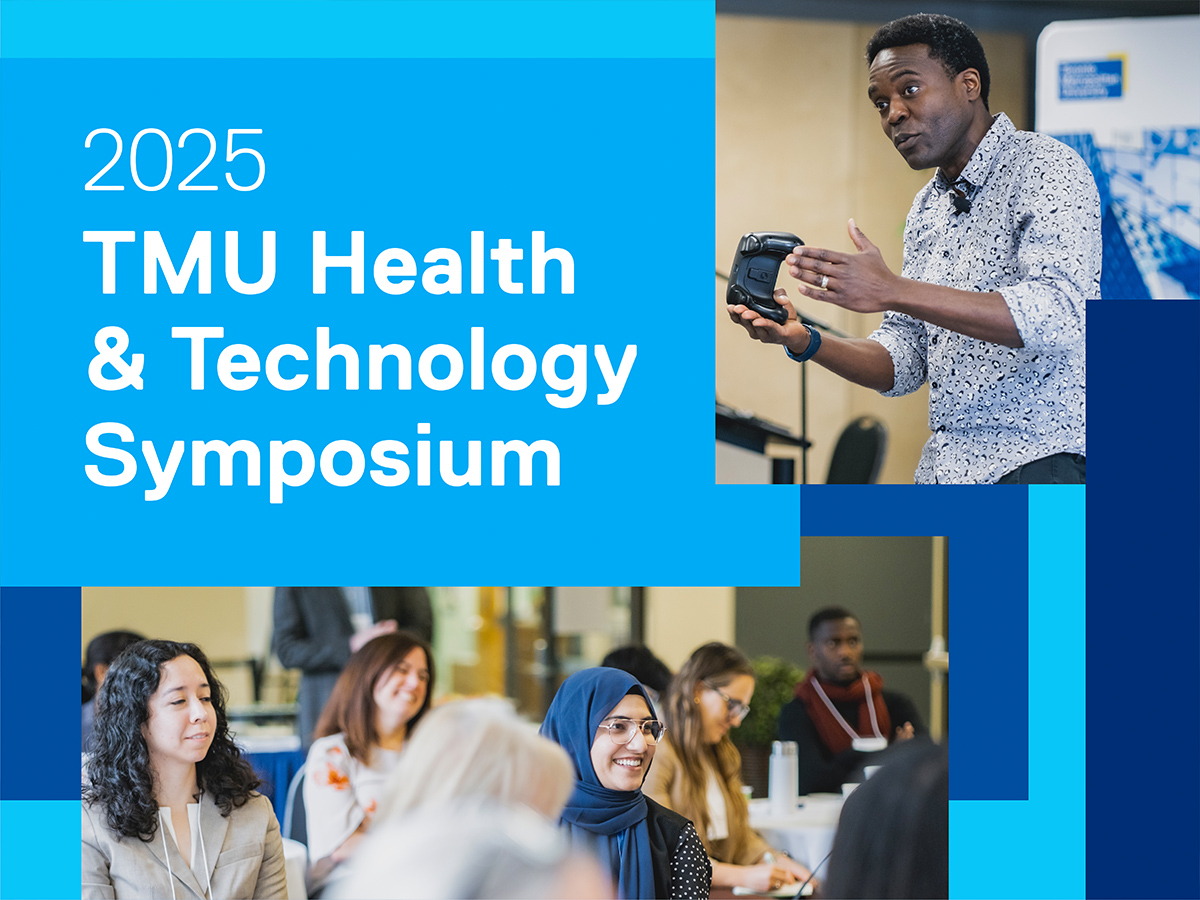
Keynote speaker Kris Alexander, professor of media production at TMU’s The Creative School, positioned himself as “the elephant in the room,” an unlikely candidate to deliver the address given his primary research focus on video game design. In his talk, “What the health? Beyond technology,” he cited multiple digital media and game-related innovations aimed at improving people’s health and well-being. Examples ranged from using virtual reality experiences of sensory-rich wintry environments to help relieve the pain of burn victims to exploring how health-care providers who appear on screen as avatars may help some patients feel safer and more open when discussing their health.
Professor Alexander also explored how digital twin technology that combines innovations in architecture, computer science, engineering and digital media could be used in health-care environments. He noted that such interdisciplinary endeavours illustrate the Medici Effect, the idea that truly transformative innovations arise when perspectives from different cultures and disciplines intersect collaboratively.
“I’m asking you to be, like I’m choosing to be, the elephant in the room,” he urged attendees. “I’m asking you to be the innovation elephant, the one that stands at the intersection of disciplines, cultures and ideas.”
Computer science professor Preeti Raman moderated the first panel, “Human-centred approaches in health care and health systems innovation,” which included speakers from professional communication, mechanical, industrial, and mechatronic engineering, psychology and nursing. Professor Raman underscored that health-care innovation “isn’t just a technical challenge, it’s a human one.” The panellists spoke about the human consequences of innovation for health-care workers and system users alike, and the ongoing need to remember the needs of the most important human in any health-care setting: the patient.
Panellist and professor Patrick Neumann, director of TMU’s Human Factors Engineering Lab, explained how the adoption of new technologies can have unintended consequences for workflow among health-care personnel, noting that nurses typically spend a quarter of their time on data entry.
“That’s a piece that often in innovation doesn’t get thought through very deeply because we’re so focused on the precision (of the technology),” he said. “It’s got to fit the work of the people, it’s got to fit the patients, and it’s got to fit the network of the organization.”
The second panel, “Mapping health through data, technology and new governance frameworks,” was moderated by Urban and Regional Planning professor Samantha Biglieri. Panellists from neuroscience, geography, law and disability studies discussed how digital technologies and AI are reshaping health research and exposing long-standing inequities. They highlighted gaps in representation in biomedical data, barriers older immigrants face in accessing digital care, concerns about data colonialism in global health and the need for more accessible, culturally grounded and community-driven technological tools.
Across disciplines, panellists emphasized that technology can either deepen inequities or expand possibilities, depending on how inclusively it is designed and governed. Psychology professor Natasha Rajah, Canada Research Chair in Sex, Gender and Diversity in Brain Health, Memory and Aging, summed this up: “We need to enrich our data sets, so we get the representativeness needed to ensure that technology has an equity-facing response in our health-care systems, rather than increasing bias.”
The final panel, “From improved diagnostics to innovative treatment solutions for health,” was moderated by physics professor Michael Kolios and included panellists from electrical, computer, and biomedical engineering, as well as chemistry and biology. The discussion ranged from improved diagnostics to innovative treatment solutions for health, with a focus on how technological advances might redefine diagnoses and treatments. The group agreed that meaningful innovation begins with clinicians identifying the challenges they face, rather than researchers independently delivering solutions that may not align with clinical needs.
Panellist and professor April Khademi, Canada Research Chair in AI for Medical Imaging, envisioned AI being used to create multimodal diagnoses that combine imaging with blood work, genomics, clinical reports and other criteria.
“We’re really going to be able to start to describe disease on a deeper level than it is today, and I think that’s pretty exciting,” she said. “We’re going to be able to get more quantitative, more accurate.”
The symposium offered a powerful reminder of what is possible when diverse thinkers, bold ideas and community-driven values come together. Throughout the event, participants and attendees shared a sense of excitement about a future of health research and innovation at TMU shaped by collaboration, creativity and a deep commitment to equity. As new partnerships emerge, the symposium stands as an inspiring example of how purposeful, interdisciplinary and intersectoral work can spark transformative change through the interplay of health and technology.
Learn more about the Health & Technology Symposium.
link