GE HealthCare submits next-gen MRI to FDA, unveils new Allia

GE HealthCare
(Nasdaq: GEHC)
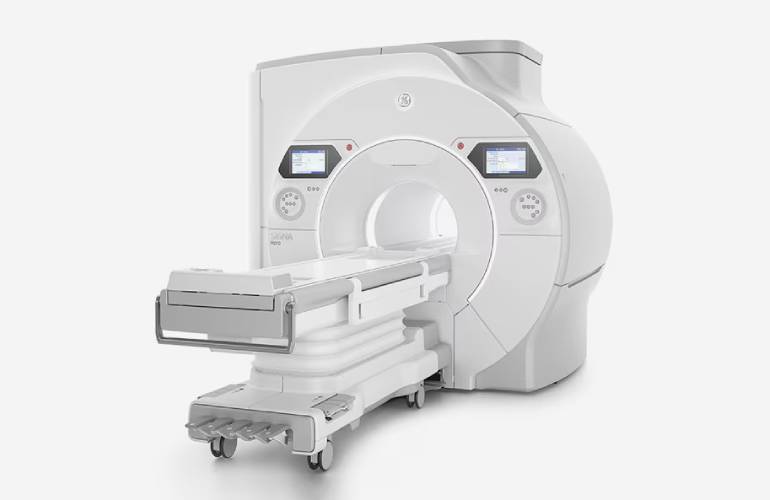
announced that it submitted its next-generation Signa MRI technology to the FDA for 510(k) clearance.
The company unveiled the Signa Bolt and Signa Sprint systems at RSNA 2025. These mark the latest technological developments for the company, which also recently unveiled a cloud-first radiology workspace.
“The urgency for greater access, efficiency and precision in MRI has never been greater. We’ve listened to clinicians who are seeking smarter, more sustainable technologies to meet today’s challenges and tomorrow’s needs,” said Kelly Londy, president & CEO, MR, GE HealthCare. “With the introduction of our advanced Signa lineup, we’re delivering on a bold vision for MRI — one that intentionally puts smarter technology to work for clinicians and patients alike to make MRI more intuitive, more efficient, and more impactful in everyday care.”
More about the technologies
GE HealthCare designed Signa Bolt to enhance precision diagnosis for clinicians and help clinicians improve patient outcomes. The company said the system includes its 1.5T MRI system, with both featuring AI-powered workflows for end-to-end exam efficiency.
Signa Bolt aims to offer the company’s most advanced high-field, clinical wide bore 3.0T MRI system. The company said it combines ultra-high gradient performance, intelligent digital radiofrequency (RF) architecture and sustainable design to deliver precision imaging, fast workflows and seamless clinical-to-research flexibility.
GE HealthCare says it achieves all this with low energy consumption and operational costs.
Signa Sprint features Freelium, aiming to broaden access to sustainable and equitable MRI technology. GE HealthCare wants to provide effortless sustainability without compromising clinical and operational efficiency.
The company designed Signa Sprint to support image quality through homogeneity, high signal-to-noise ratio (SNR) and image clarity. It integrates with the company’s deep learning solutions, including AIR Recon DL and Sonic DL.
Signa Sprint’s Freelium ventless magnet allows installation virtually anywhere, the company says. It features two levels of operational autonomy to empower radiology departments. Scanning autonomy simplifies scanning, while Autoramp technology uses intelligent sensors to support automated magnet recovery.
Signa One powers both new MRI platforms
GE HealthCare also shared information about its next-generation, AI-powered workflow platform to improve the imaging experience called Signa One.
It offers an intuitive experience that can help. reduce training time and aims to boost productivity while shortening the learning curve. Its Signa One table enhances patient comfort and simplifies patient transport, the company says.
GE HealthCare said the fully automated Signa One camera features in-room console live feeds, AI-enabled landmark localization and patient positioning. verification. It has real-time visual guidance on a touchscreen display to improve speed and accuracy.
The system also has contactless respiratory and peripheral gating to capture physiological data effortlessly, regardless of patient orientation. High-resolution, in-room consoles empower technologists with simple patient setup control.
GE HealthCare said it integrated its platforms with Nvidia technology as well to enhance the performance and intelligence of MR. It utilized Nvidia’s RTX product line and Signa One to power Signa Bolt and Sprint.
“We’re dedicated to making every interaction smooth, fast and patient centric by using predictive technology that boosts efficiency,” said Bryan Mock, PhD, GM global product segment, Premium MR, GE HealthCare. “SIGNA One technology is designed to simplify and improve the efficiency of experienced users, while aiming to shorten the learning curve for new users. Regardless of a users’ experience level, SIGNA One aims to liberate users from inefficiencies at every stage of the MR imaging process.”
GE HealthCare also unveils new Allia system
In addition to the Signa technologies, GE HealthCare also unveiled Allia Moveo. This image-guided solution aims to enhance mobility and flexibility and redefine care in the interventional suite. It builds on the company’s existing Allia platform.
The new Allia platform features a slim, compact, cable-free C-arm, allowing full movement and patient access while delivering strong image quality. Its wide-bore C-arm enables cone beam computed tomography (CBCT) that accommodates a diverse patient population, an ergonomic design and AI-powered tools to provide a seamless workflow and personalized care.
Allia Move’s design ensures full access to the patient during both simple and complex procedures. It also has comfort-enhancing features for patients who may benefit from the wide bore and effortless table panning. New features enhance efficiency, like Smart Move for the clinician to move the C-arm away from the patient whenever needed.
The system also has AI tools and augmented guidance that support advanced workflows to enable greater precision.
Allia Moveo is currently FDA 510(k) pending.
“As demand for minimally invasive procedures continues to increase, clinicians are navigating greater complexities and volume, and need technology that keeps pace to enhance precision, simplify workflows, and support efficient care delivery,” said Philip Rackliffe, president and CEO, Advanced Visualization Solutions (AVS) at GE HealthCare. “Allia Moveo aims to set a new standard in interventional care, reduce barriers, and anticipate clinical needs, with the goal of empowering clinicians to deliver optimal patient outcomes with comfort and confidence.”
link