


By
Lan Do
Wed, August 6, 2025 | 4:06 pm GMT+7
Japanese investment in Vietnam is seeing a notable shift, with sharp increases in the services, trade, and technology sectors, while investment in manufacturing has slowed, said Abe Ryota, a senior economist at Sumitomo Mitsui Banking Corporation (SMBC).
Abe shared his insight at the Ho Chi Minh City-Hyogo Economic Forum 2025 on Tuesday in HCMC. He highlighted a clear change in Japan’s investment trends in Vietnam. As of 2023, the number of Japanese companies headquartered in Vietnam had jumped from 1,944 to 2,394 – a significant increase.

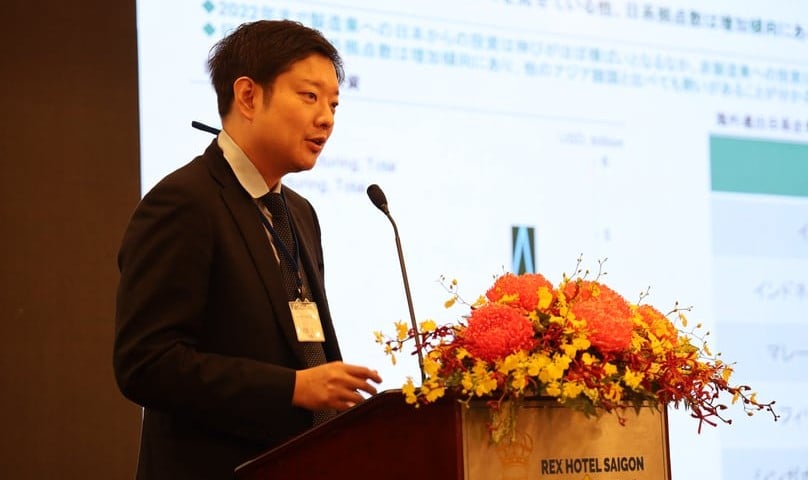
Abe Ryota, a senior economist at SMBC, speaks at the Ho Chi Minh City-Hyogo Economic Forum 2025 in Ho Chi Minh City on August 5, 2025. Photo courtesy of the organizer.
Abe noted that cash and deposits held by Japanese non-financial corporations are currently at record highs, and the mindset is shifting from saving to investing. This rising trend in outbound investment – particularly in renewable energy, green infrastructure, and industrial real estate – presents Vietnam with strong opportunities, provided they are seized at the right time.
In tourism and aviation, the internationalization of Kobe Airport could pave the way for direct charter flights between Kobe and Vietnam. This would not only enhance human resource exchange but also bridge the distance between investors, businesses, and production bases in both regions.
Hattori Yohei, deputy governor of Hyogo Prefecture, emphasized the long-standing partnership between HCMC and Hyogo, which began in 2007 with an MoU on cooperation. This partnership has steadily grown over time and is regularly reinforced through rotating economic forums. The extension of the MoU in May 2024 marked a strategic move, underscoring both sides’ commitment to long-term, comprehensive collaboration.
A key area of cooperation is human resource development. Hyogo is leading efforts to establish a certification system for companies that are friendly to foreign workers, helping Vietnamese employees feel confident about working, studying, and building careers in Japan. Hattori expressed hope that these workers, upon returning home, would continue contributing to Japanese businesses operating in Vietnam – creating a sustainable human resource cycle.
Hyogo-based companies are grappling with an aging population and a shortage of high-quality labor. As a result, they are accelerating the adoption of advanced technologies such as automation, AI, and smart manufacturing – an opportunity for HCMC’s tech, startup, and logistics companies to engage in meaningful collaboration.
Speaking at the forum, Nguyen Loc Ha, Vice Chairman of the HCMC People’s Committee, stated: “The city consistently places people at the center of its development strategy and refuses to sacrifice the environment for short-term economic gain.” This approach reflects a modern vision of sustainable development and the city’s sense of responsibility during a period of significant transformation.
HCMC, Vietnam’s biggest economic engine, has identified three strategic growth drivers for the new era: digital transformation, green transformation, and innovation. The city has already rolled out its Green Development Strategy Framework toward 2030, with a vision extending to 2050.
The strategy is built on four pillars: developing green human resources, constructing green infrastructure, fostering green lifestyles, and leading in green sectors. Ho Chi Minh City aims to cut greenhouse gas emissions by 10% by 2030 and reach net-zero emissions by 2050, aligning with Vietnam’s COP26 commitments.
A major milestone is approaching on July 1, 2025, when HCMC entered a new phase of development through an administrative merger with Binh Duong and Ba Ria-Vung Tau provinces, two industrial hubs in southern Vietnam.
This “super urban area” model will expand growth potential, strengthen regional connectivity, and promote the restructuring of production, logistics, and high-tech value chains across the Southeast region.
Pham Binh An, deputy director of the HCMC Institute for Development Studies, stated that the expanded city will move away from traditional industrial urban planning and instead focus on building a green, circular, and digital economy. The city has identified six priority sectors for green transformation: energy, industry, transportation, urban infrastructure, trade and services, and agriculture.
A standout initiative is the “Green Can Gio” project, which aims to create HCMC’s first net-zero urban area. A key component of this project involves assessing the carbon reserves of the Can Gio mangrove forest – potentially enabling the city to join the international carbon credit market, a new yet promising area amid the global push for green finance.
Furthermore, HCMC is actively converting traditional industrial zones into eco-industrial and circular models. This transition is essential to meet the growing environmental standards and overcome green trade barriers effective in major export markets such as the EU, Japan, and the U.S.
link